
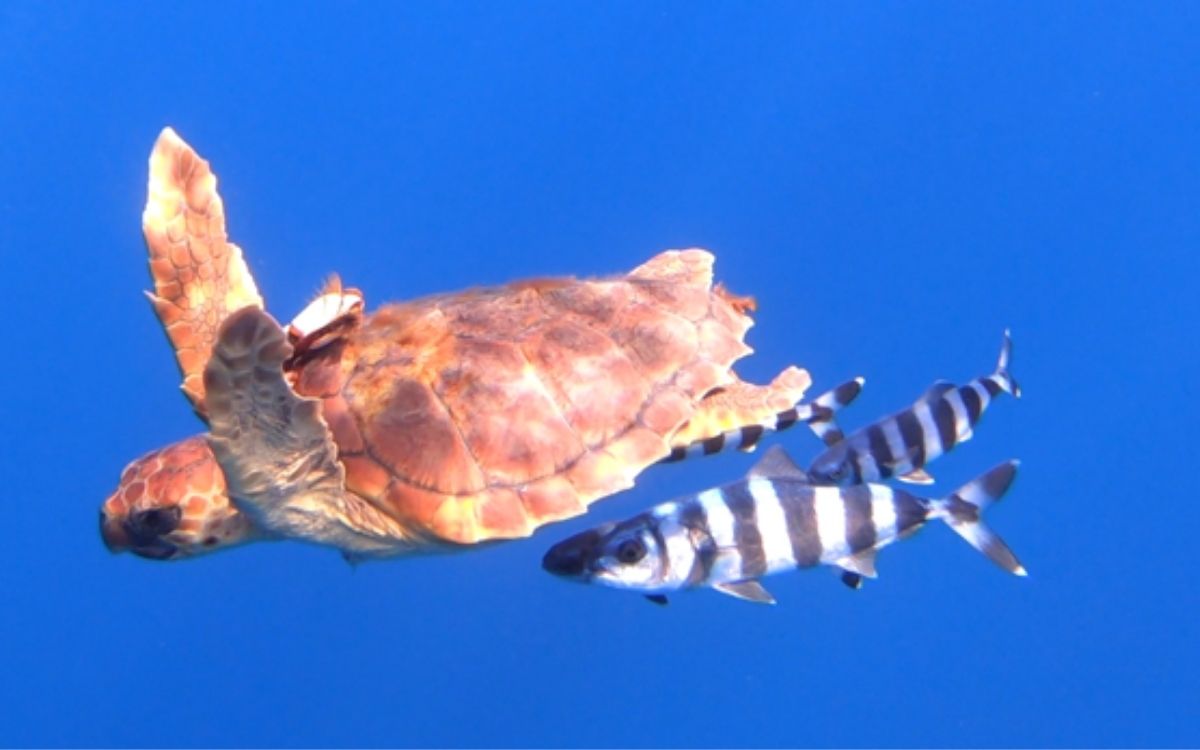
We’re at anchor, everyone’s in the water, and suddenly someone shouts from the bow. It’s not a dolphin. It’s a small head popping up to breathe a few metres from the hull; it stays there for a moment, looking around, and then slowly dives back down.
It happens almost every day. And the funny thing is, we never go out looking for them.
Several species live in the waters around the Canary Islands, the most common being the loggerhead turtle, Caretta caretta. It is the one with a brown shell and a large head, which is almost always seen floating on the surface basking in the sun before diving back down.
They turn up when you’re not looking for them
We set out to sail and keep an eye out for dolphins or whales. The turtles turn up on their own, without warning, almost always whilst we’re stopping for a swim or as we sail along the coast. The same goes for the manta rays, which also make an appearance from time to time.
That’s why people love them so much: they’re not part of the script. Nobody promises them to you when you book, and yet they end up being the story you tell when you get back to the hotel.
A story that began in Cofete
Here’s something many people don’t know, and it’s a story that involves the whole of Fuerteventura. On Cofete beach, work has been underway for years on a project to reintroduce the loggerhead turtle, spearheaded by the Canary Islands Government using eggs from Cape Verde. The species had not nested on the islands for nearly three hundred years.
And there’s one detail that gives you goosebumps: turtles practise philopatry, which means that as adults they tend to return to the beach where they were born to lay their eggs. That means that some of those that grew up on the sands of Cofete may one day return to Fuerteventura. When you’re sailing around here and see one pop up, it’s hard not to think about it.
A turtle hospital in our very own harbour
At the port of Morro Jable, just a few metres from where we moored, is the Fuerteventura Island Council’s Sea Turtle Recovery and Conservation Centre. Turtles that are found injured or entangled are taken there, treated and, once they have recovered, released back into the sea.
Admission is free, although it’s a good idea to check the opening times beforehand as they vary depending on the season. If you’re in the area with children, it’s a short outing that’s well worth it.
Two who came with us
Of all the ones we’ve seen, there are two that the crew remembers in particular. One had a cracked leg and wasn’t moving very well. We lifted it carefully on board and placed it in the centre so it could be treated.
The other one had a shell covered in growths, right near its neck, which was preventing it from swimming properly. Same story: off to the centre, cleaned up, nursed back to health, and back into the Atlantic once it was ready. Finishing the day like that really turns anyone’s day around.
If you ever come across an injured turtle or one that has become stranded on the beach, it is best not to touch it and to call the emergency services so that the professionals can deal with it.
When it happens, it’s best to do nothing
We treat them in the same way as we do cetaceans: we don’t chase them, we don’t touch them and we don’t invade their space. It’s the same idea that sums up our Blue Boat code. If it decides to stay near the boat for a while, you enjoy the moment; if it swims away, you let it go.
See you at the quay in Morro Jable
We can’t promise you’ll see a turtle, just as we don’t promise dolphins. What we do know is that this stretch of the Atlantic is teeming with life and that no two trips are ever the same.

- What lies beneath our waters? What you’ll see when you take a dip on our excursions in Fuerteventura - 18 September 2026
- Sea turtles in Fuerteventura: the visit nobody expects - 7 September 2026
- Respecting the home of cetaceans in Fuerteventura: the Blue Boat code
- 27 August 2026
